
Three longtime Department of Chemical Engineering professors are retiring this year. They are known for their years of dedication to research, academics and, certainly, student mentorship.
Retiring faculty
- Mark Orazem, Ph.D.
- Spyros Svoronos, Ph.D.
- Sergey Vasenkov, Ph.D.
Mark Orazem, Ph.D.
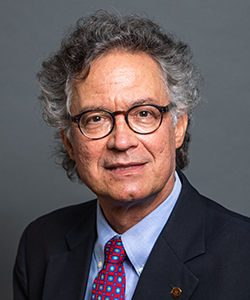
After 38 years at UF, Orazem is retiring as a globally recognized expert in electrochemical impedance spectroscopy and a deeply influential mentor.
Spend any time in Chemical Engineering Distinguished Professor Mark Orazem’s office and you’ll see elephants—lots of them. Students and family have gifted him elephants, large and small, over the years.
Elephants and their iron-clad memories seem appropriate as Orazem prepares to retire from the University of Florida at the end of 2026. Like those elephants, he has a lot of memories to process — 38 years’ worth.
Orazem is known for his contributions to battery technology, glucose sensors, automotive energy systems, electronic materials (semiconductors), biomedical probes and corrosion. He’s a renowned expert in electrochemical impedance spectroscopy, a type of transfer-function measurement in which the response to a current or potential input is used to assess system properties.
He spent decades developing and testing modeling systems that interpret impedance response data. He began this work in the 1980s using FORTRAN and has recently updated his modeling platform to run on Python (with assistance from a student). The software—“a cool program,” he calls it—is freely available on his website.
Orazem is a widely respected researcher whose career will be honored in May by the Electrochemical Society with a symposium in his honor. But it is his connection with students that he cherishes most.
“I’ve always believed that the biggest impact that we can make as a professor is not through the research that we do, but it’s through the connections we make with students,” he said.
“I’ve had the ability to reach thousands of people around the world, and that feels really good.”
A Nyquist plot showing the impedance of corroding electrochemical systems—Orazem’s specialty—resembles an elephant. That connection also became a symbol of his lab culture, as described by Ming Gao, Ph.D., who received her doctorate under his guidance in 2020.
“The elephants standing trunk-to-tail, each one holding onto the next, became a quiet symbol of our lab culture,” she said. “It represented continuity and connection—the older guiding the younger, and each generation supporting the next. Dr. Orazem led with patience, steadiness and deep care for our growth, both scientifically and personally.”
Elephants also connect to the parable of the blind men and the elephant, in which each person describes the animal based on limited perspective. For Orazem, the lesson is clear: no single measurement can fully describe an electrochemical system—multiple perspectives are needed to understand the whole.
As he puts it, impedance spectroscopy is just one way of “touching the elephant.”
“I’m grateful. As I look back on my career, I just feel this sense of gratitude,” he said. “I love this job. A lot of my colleagues see me as not ready to retire, but I’m 71 now. What I’d really like to do now is retire gracefully.”
Orazem is a Fellow of the American Association for the Advancement of Science (AAAS), the Electrochemical Society and the International Society of Electrochemistry, serving as president of the latter from 2011 to 2013. He has written more than 220 refereed publications and co-authored Electrochemical Impedance Spectroscopy with Bernard Tribollet of the CNRS in Paris.
Spyros Svoronos, Ph.D.

After 44 years at the University of Florida, a much-loved professor is retiring.
Spyros Svoronos, Ph.D., is a dedicated instructor and an accomplished researcher whose work focuses on the modeling and optimization of bioprocesses. He served the Department of Chemical Engineering (CHE) as associate chair for undergraduate studies for many years and served as interim chair for almost two years.
He held the inaugural Harry & Bertha Bernstein Professorship of Chemical Engineering from 2016 to 2024.
Svoronos will leave an indelible mark on the department when he retires at the end of the spring semester.
“No one has given more in service of our students’ interests than Spyros,” said Richard Dickinson, Ph.D., interim CHE chair.
“As director of undergraduate studies, he personally assigned himself a heavier-than-fair teaching load during the academic year and, for many years, created and taught a special summer ‘mega-course’ covering a wide range of process-related topics,” Dickinson recalled. “When I conducted student exit interviews as chair, Spyros was overwhelmingly named the undergraduates’ favorite professor.”
Svoronos received his bachelor’s degree in chemistry from Oberlin College in 1976, followed by his doctorate from the University of Minnesota in 1981. He joined UF in 1982.
Of note at UF, he played an integral part in developing the multidisciplinary college-wide Integrated Product and Process Design course. Svoronos was the principal investigator for the proposal that obtained startup funding. IPPD celebrated 30 years in 2025.
Svoronos also stepped forward whenever the department needed him, serving as interim chair and guiding the department through multiple ABET accreditation cycles as the department’s accreditation coordinator.
Dickinson also admired Svoronos’ engaging style.
“When I visited UF for my interview in 1993, Spyros’ infectious enthusiasm and unassuming warmth immediately stood out and played a big role in my decision to join the UF family,” Dickinson remembered. “I still remember him picking me up at the airport in his big, green, beat-up old car—remarkably like my own. That moment captured something essential about Spyros: genuine, welcoming and entirely unpretentious.”
CHE Distinguished Professor Mark Orazem, Ph.D., also remembered Svoronos’ energy. “Spyros was on the faculty at UF in 1987 when I was being recruited,” he recalled. “My memory of his enthusiasm for me to join the department still makes me smile today.”
Orazem also highlighted Svoronos’ absolute dedication to his students. “His lectures are energetic and even a bit manic, but he knows the students individually and does his best to help them succeed,” he said. “I treasure Spyros as a friend and colleague,” he added.
Sergey Vasenkov, Ph.D.

Chemical Engineering Professor Sergey Vasenkov, Ph.D., is retiring after 20 years at the University of Florida.
Vasenkov came to the University of Florida by way of Russia and Germany.
He received his master’s degree in 1989 from Novosibirsk State University, a public research university in Novosibirsk, Russia. He earned his doctorate in 1994 from the Institute of Chemical Kinetics and Combustion, also in Novosibirsk.
After getting his Ph.D., he worked as a postdoc at Lawrence Berkeley National Laboratory for three years. He later spent time at Leipzig University, Germany, as a postdoc researcher.
There, he earned a habilitation, a high qualification for independent research and teaching in a given field.
He began teaching at UF in January 2006 and was selected as Herbert Wertheim College of Engineering Teacher of the Year in 2010 and 2018. He received a National Science Foundation CAREER award in 2010 and the UF Term Professorship Award in 2017.
He also received the Hanse-Wissenschaftskolleg Senior Fellowship in 2015 from the Hanse-Wissenschaftskolleg Institute for Advanced Study in Delmenhorst, Germany, and the German Science Foundation Mercator Fellowship in 2018.
Vasenkov’s research focused on developing a fundamental understanding of transport of molecules and ions in membranes, sorbents, catalysts, ionic liquids and related materials on a broad range of microscopic length scales; microscopic gas transport in gas-separation membranes and catalysts; and transport-structure relationship in membranes with ionic properties.
“I deeply appreciate and value the spirit of collaboration and mutual support in a department that became my professional home,” Vasenkov said.
Together, these three faculty members leave a lasting legacy in research, education and mentorship within the Department of Chemical Engineering.