
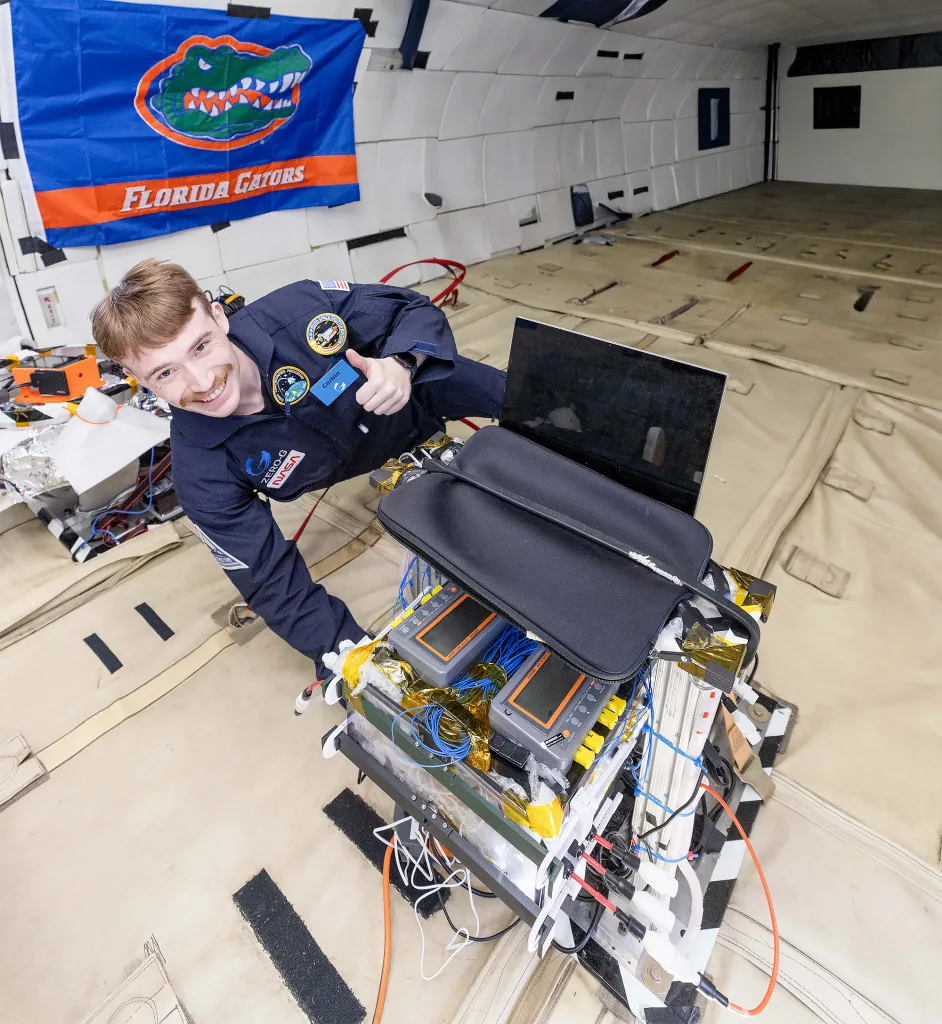
Thomas Corbin
Degree: Ph.D. Student
Advisor: Ranga Narayanan, Ph.D.
Thomas Corbin first fell for the Gator Nation when he was a visiting chemical engineering undergraduate from North Carolina State. He declared UF was where he wanted to be, and he returned to pursue his doctoral studies.
“I appreciate attending a university that values all aspects of campus life,” he said. “From a strong athletic program to being a premier research institution with significant investments in its facilities, UF offers a well-rounded experience.”
And Corbin has discovered you never quite know when you might run into a fellow Gator.
“Whether walking the streets of New York City or visiting government organizations like NASA Marshall, I have run into UF alumni with whom I can instantly connect over our shared educational experience,” he said.
Corbin is now in the fourth year of his Ph.D. studies, and his research focuses on mathematics and the physics of instabilities in fluid layers and droplets for space and artificial intelligence applications.
One research focus is generating resonant instability — or Faraday instability. That is a fluid-dynamics phenomenon in which waves are formed on a liquid when vibrations are applied perpendicularly to the surface.
Corbin will use his findings to improve heat transfer in systems in space, for example.
His other research focus is generating resonance on electrostatically levitated molten metal droplets on earth, as well as on the International Space Station, or ISS, to determine thermophysical properties for advanced manufacturing processes.
His research is conducted in the Non-linear Instability and Bifurcation Laboratory, which is run by Corbin’s advisor, Ranga Narayanan, Ph.D.
Narayanan has nothing but praise for Corbin and the experiments he has designed using simulated “near weightlessness.” In fact, he calls him “Mr. Microgravity” because of his experiments conducted on aircraft during maneuvers that follow large parabolic trajectories.
“The contents of the aircraft will also feel as if they have lost gravity and will feel near weightlessness,” Narayanan explained. “Experiments on an aircraft during such maneuvers will experience near-zero gravity, and fluids in those experiments will behave differently than on Earth. It is a way to get low gravity for 18 seconds,” Narayanan explained.
He said Corbin also conducted remote experiments on the ISS from ground facilities in Japan.
“Those experiments,” Narayanan said, “have applications in space thermal management and thermal management in AI data centers on Earth.”
Corbin’s appreciation of Ranga is mutual.
“I have had the opportunity to travel internationally with Ranga to both Japan and France — experiences that allowed me to explore places I never imagined I would visit,” he said. “These trips were not only culturally enriching but also academically meaningful, as they were closely tied to our research collaborations.”
The two have spent a great deal of time, often at a whiteboard, discussing the underlying physics and mathematics of fluid instabilities, debating and analyzing various physical phenomena to better connect experimental results with theoretical understanding.
“This mentorship has been incredibly impactful, and it is an experience I will truly miss after I graduate,” Corbin said.
Corbin keeps his feet on the ground by going on long walks around Gainesville and taking advantage of local nature preserves such as Sweetwater Wetlands Park and Paynes Prairie.
He enjoys taking photos of the wildlife, especially alligators and the elusive Osceola turkey. His favorite animal species is the grizzly bear, but his absolute favorite animal is his cat, Beans. He got her in his first year of graduate school and says, “She has been my partner in crime and my buddy ever since.”